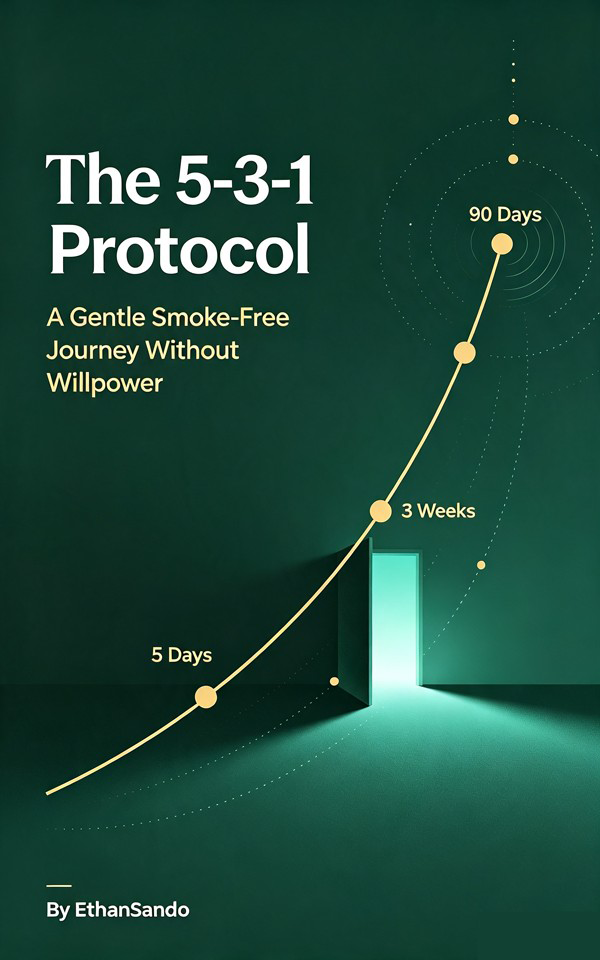
The 5-3-1 Protocol
A Gentle Smoke-Free Journey Without Willpower
From 26 Years of Heavy Smoking to Ten Years Tobacco-Free
Buy Now — $11.49What this book gives you
- 5-Day Body Adaptation — navigate peak physical withdrawal
- 3-Week Habit Reset — identify & replace your smoking triggers
- 1-Quarter Identity Lock-In — shift from "trying to quit" to "I don't smoke"
- The Detour Chapter — what to do when you slip, without starting over
- 📱 The Walk — daily check-in with progress map included
This is the exact framework I used to go 10 years smoke-free.
Read the first chapters free
Tap to read each section free.
Foreword
I smoked for twenty-six years.
Not the occasional social cigarette. A pack a day. Sometimes more. For twenty-six years, cigarettes were just part of my life. At first, I never even thought about quitting. Everyone around me smoked. I smoked. It didn't seem like a problem.
The shift didn't stem from one life-altering epiphany; it built up slowly from dozens of tiny, painful moments.
The first thing was my body. Every morning, I'd wake up with a bitter taste in my mouth that wouldn't go away no matter how many times I brushed my teeth. It was that stale, overnight cigarette tar taste, rising from the back of my throat. My throat always felt rough, like something was stuck there that I couldn't clear. But I told myself the same thing every smoker tells themselves: "Everyone who smokes deals with this."
Then there was my family. They never said anything harsh. They'd just quietly leave the room when I lit up. That silence was heavier than any argument. When we had children, I started hiding — on the balcony, downstairs, anywhere I thought the smoke wouldn't reach. But kids notice everything. Once, I picked up my child and he frowned, saying "Daddy smells bad." That look on his face — I still remember it clearly.
Work became an issue too. I couldn't sit through a meeting without thinking about when I could slip out for a cigarette. Once, during a client meeting, I rushed out during the break to smoke. When I came back, I saw the client's nose wrinkle slightly. Just a tiny reaction. But I knew he could smell it. The discomfort wasn't about being judged — it was knowing that my own habit was making me look unprofessional.
I smoked for twenty-six years.
Not the occasional social cigarette. A pack a day. Sometimes more. For twenty-six years, cigarettes were just part of my life. At first, I never even thought about quitting. Everyone around me smoked. I smoked. It didn't seem like a problem.
The shift didn't stem from one life-altering epiphany; it built up slowly from dozens of tiny, painful moments.
The first thing was my body. Every morning, I'd wake up with a bitter taste in my mouth that wouldn't go away no matter how many times I brushed my teeth. It was that stale, overnight cigarette tar taste, rising from the back of my throat. My throat always felt rough, like something was stuck there that I couldn't clear. But I told myself the same thing every smoker tells themselves: "Everyone who smokes deals with this."
Then there was my family. They never said anything harsh. They'd just quietly leave the room when I lit up. That silence was heavier than any argument. When we had children, I started hiding — on the balcony, downstairs, anywhere I thought the smoke wouldn't reach. But kids notice everything. Once, I picked up my child and he frowned, saying "Daddy smells bad." That look on his face — I still remember it clearly.
Work became an issue too. I couldn't sit through a meeting without thinking about when I could slip out for a cigarette. Once, during a client meeting, I rushed out during the break to smoke. When I came back, I saw the client's nose wrinkle slightly. Just a tiny reaction. But I knew he could smell it. The discomfort wasn't about being judged — it was knowing that my own habit was making me look unprofessional.
These things piled up. Eventually, I started thinking seriously: maybe it's time to stop.
I can't remember how many times I tried to quit. Every attempt followed the same pattern. I'd make a firm decision at night, throw away whatever cigarettes I had left, and convince myself this time would be different. I'd last two days, sometimes three. Then something would happen — a stressful moment at work, an argument, or sometimes nothing at all — and I'd feel that overwhelming urge. When I finally lit that cigarette, the taste wasn't what I remembered. It was bitter, harsh, and made my head spin. My body was actually rejecting it. But the physical discomfort passed quickly. What lingered was the feeling of failure. "I messed up again."
And once I'd broken my streak, I'd go all in. I'd smoke even more than before. Then weeks or months later, when my morale recovered, I'd try again. This cycle repeated for years.
Maybe you're stuck in that same cycle right now. Or maybe it's someone close to you. You're trying to find a way out. You've searched online, taken friends' advice, flipped through books. Nothing quite fits.
The smoking cessation world offers several approaches. Some focus on the science — explaining nicotine metabolism and dopamine receptors in detail. You learn exactly why you're addicted, but still don't know how to stop. Others rely on fear — pictures of damaged lungs, cancer statistics, life expectancy calculators. Those scare you for a moment, then you light up to calm your nerves. Some emphasize motivation — "You can do it!" and "Stay strong!" — as if determination was all you were missing. And then there are replacement products: patches, gum, e-cigarettes. Different ways to keep feeding the same addiction.
Each approach has its merits. Each has helped someone. But they all share a common gap: they tell you where to go, but not how to walk there step by step. They give you a destination without a map.
What I eventually developed isn't another theory. It's simply the route I walked myself, broken down into three segments. How long each segment takes. What the hardest part of each segment feels like. What changes after you get through it. It's not a set of rules. It's a map drawn from my own experience.
I'm not a doctor or a professional cessation counselor. I'm just someone who smoked for twenty-six years, tried everything, failed repeatedly, and finally found a way that worked. I have lived completely tobacco-free for ten full years. If I can do it, you probably can too.
Ready? Let's begin.
Chapter 1
It took me a long time to figure this out. If someone had told me this while I was still smoking, I probably would have brushed it off. "Pleasure is pleasure. Why overthink it?" But there was something I hadn't understood. The satisfaction I attributed to cigarettes never truly originated from smoking itself. It came from the relief of a discomfort the cigarette itself had created.
This isn't wordplay. Think about it carefully.
When you wake up in the morning, why do you want that first cigarette? Because your body has gone several hours without nicotine. The nicotine level in your blood is dropping. You start feeling slightly restless, uneasy, maybe a bit empty. You think "I want a cigarette," but what's really happening is your body signaling: nicotine levels are low, time to refill. You light up, nicotine returns to your bloodstream, and that uneasy feeling disappears. You mistakenly credit the cigarette with calming you down. But the truth is — the cigarette only temporarily relieved the discomfort it created in the first place.
This cycle is relentless. Look at your typical day. Roughly every hour or two, the nicotine concentration in your blood drops to a level that makes you subtly uncomfortable. You might not consciously register the discomfort, but you'll feel an urge to smoke. You think it's your own desire. It's not. It's just nicotine's alarm clock going off in your body.
During all my smoking years, I was never truly free. I'd sit in meetings mentally counting down the minutes until I could step outside. On long flights, I'd calculate how many hours until landing. Watching a movie, I'd get restless halfway through — not because the movie was boring, but because nicotine's alarm was ringing again.
Consider what happens after an argument. Your heart rate spikes, emotions run high. You feel like you need to "calm down." You step outside, smoke a cigarette, and gradually feel your emotions settle. But was that really the cigarette's doing? You removed yourself from the tense environment. You spent five minutes breathing — even if it was smoke-filled air. You had a moment of quiet. Those things naturally calm a person down. The cigarette just took the credit.
It took me a long time to figure this out. If someone had told me this while I was still smoking, I probably would have brushed it off. "Pleasure is pleasure. Why overthink it?" But there was something I hadn't understood. The satisfaction I attributed to cigarettes never truly originated from smoking itself. It came from the relief of a discomfort the cigarette itself had created.
This isn't wordplay. Think about it carefully.
When you wake up in the morning, why do you want that first cigarette? Because your body has gone several hours without nicotine. The nicotine level in your blood is dropping. You start feeling slightly restless, uneasy, maybe a bit empty. You think "I want a cigarette," but what's really happening is your body signaling: nicotine levels are low, time to refill. You light up, nicotine returns to your bloodstream, and that uneasy feeling disappears. You mistakenly credit the cigarette with calming you down. But the truth is — the cigarette only temporarily relieved the discomfort it created in the first place.
This cycle is relentless. Look at your typical day. Roughly every hour or two, the nicotine concentration in your blood drops to a level that makes you subtly uncomfortable. You might not consciously register the discomfort, but you'll feel an urge to smoke. You think it's your own desire. It's not. It's just nicotine's alarm clock going off in your body.
During all my smoking years, I was never truly free. I'd sit in meetings mentally counting down the minutes until I could step outside. On long flights, I'd calculate how many hours until landing. Watching a movie, I'd get restless halfway through — not because the movie was boring, but because nicotine's alarm was ringing again.
Consider what happens after an argument. Your heart rate spikes, emotions run high. You feel like you need to "calm down." You step outside, smoke a cigarette, and gradually feel your emotions settle. But was that really the cigarette's doing? You removed yourself from the tense environment. You spent five minutes breathing — even if it was smoke-filled air. You had a moment of quiet. Those things naturally calm a person down. The cigarette just took the credit.
What about after meals? You finish eating, your body naturally relaxes into a state of satisfaction. You light a cigarette and associate that natural post-meal contentment with smoking. The cigarette didn't create the satisfaction — it hijacked it.
And when you're bored? You're restless, your hands are idle. Smoking gives you something to do with them. It doesn't cure the boredom — it just occupies you during it. Like scrolling through your phone when you have nothing else to do. You don't thank your phone for saving you from boredom. You're just passing time. Same with cigarettes.
After I finally quit, looking back at all those moments, I realized every scenario where I thought "smoking makes me feel good" followed the same pattern: the cigarette first created a discomfort, then sold me the relief.
Nicotine metabolizes extremely fast. About two hours after you finish a cigarette, the nicotine concentration in your blood drops by half. A few more hours, and it drops further. Your body starts feeling slightly off — and that's the real source of your craving. When you smoke every hour or two, you're just constantly topping up your nicotine levels, keeping your body in a perpetual state of being "fed."
If you had never started smoking in the first place, you wouldn't need any of this. You wouldn't feel like something is missing after meals. You wouldn't need to step outside after arguments. Your fingers wouldn't automatically reach for your pocket when you're bored. Non-smokers don't need cigarettes to feel normal — because they never had nicotine's alarm clock installed in their bodies.
This is the first thing I want you to understand. You've never gotten real pleasure from smoking. You've just been feeding a hunger loop, then mistaking the relief of that hunger being satisfied for genuine enjoyment.
This loop isn't your fault. Nicotine is one of the most addictive substances known. It's designed to trap you this way. You're not weak-willed. You're caught in the same cycle as millions before you and millions more who are reading this book alongside you.
The good news is that this cycle can be broken. Not through willpower. Not through white-knuckling. But through understanding how it operates and then walking yourself out of it, step by step.
I didn't quit because I was stronger than anyone else. I quit because I finally saw the loop for what it was, and found a way to walk through it without fighting it head-on. The next chapter explains why fighting it head-on — relying on willpower alone — almost always fails.
You've reached the end of the free preview.
You just read the Foreword and Chapter 1 — the foundation of the entire 5-3-1 system.
The full book continues with Chapter 2–12, the Detour chapter, and 3 appendices.
Get the full book — $11.49Full eBook — $11.49
- ✔ PDF (A5 print-ready)
- ✔ EPUB (Kindle / Apple Books / Kobo)
- ✔ The Walk — smoke-free daily check-in with journey map
No refunds after download. You've read the Foreword and Chapter 1 free.
Secure PayPal Checkout · Instant email delivery
Disclaimer: This book shares personal experience and behavioral guidance only. It is not medical advice. If you experience severe withdrawal symptoms, consult a healthcare professional.